
Here's What to Expect In This Episode:
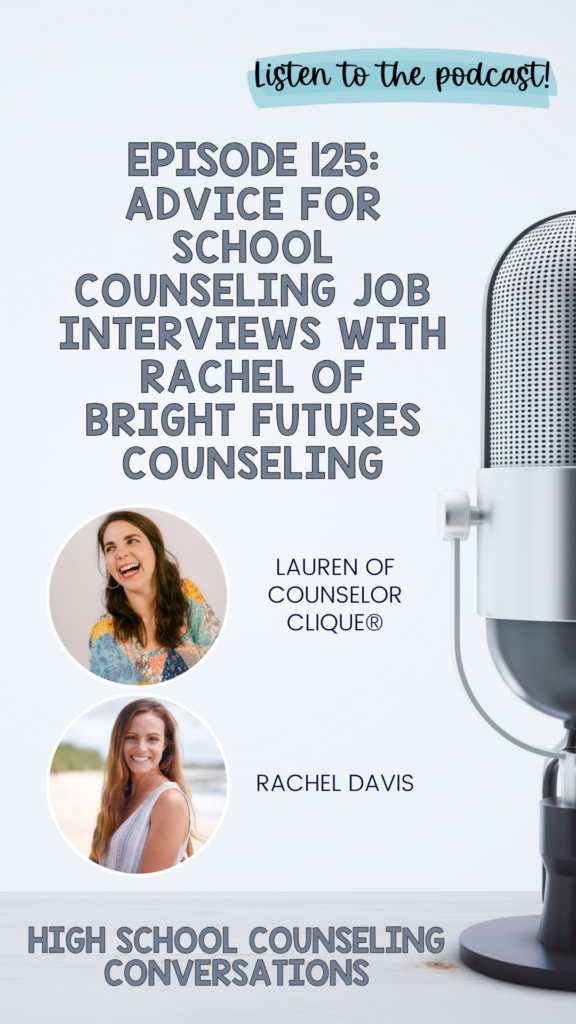
This is the time of year when you might start looking for new opportunities in the form of a new counseling job. Whether you’re a student who just graduated college, a parent coming back into the workforce after staying home with your children, or just looking for a new place to help students, this episode is for you! I have my friend, Rachel Davis, on today, and we’re sharing our best school counseling interview advice in hopes of giving you encouragement and tips as you enter the job search scene.
When interviewing for school counseling positions, there’s a lot that goes into it. Rachel and I are breaking down the different components of interviews, such as resumes, second interviews, how to respond to different scenarios, and marketing yourself to be the best for the position. Along with sharing how we’d handle different scenarios, we’re also giving general advice on how to make the biggest impact during your interview.
Being on both sides of the interview process, Rachel and I have an open and honest conversation about our dos and don’ts as you look for a new job. No matter what your current situation is, we’re sharing our best school counseling interview advice to get you your dream counseling job!
Topics Covered in This Episode:
- Rachel and I share our best school counseling interview advice
- How to use your own experience to your advantage during interviews
- Basic interview tips that help you stand out from the crowd
- Our advice on how to handle certain scenarios such as gap year, changing grade levels, and not getting a job yet
Resources Mentioned in This Episode:
- Freebie: 3 Day Interview Video Challenge
- Resource: High School Counselor Kickstart Audio Course
- Community: Find your new high school counselor community in the Clique Collaborative membership
- Free PDF Download: Sample School Counseling Interview Questions from ASCA
- Leave your review for School Counseling Conversations on Apple Podcasts
Other Blog Posts You Might Like:
- Blog: 3 Popular Interview Questions to Prepare for Your High School Counseling Job Interview
- Blog: Dear New School Counselor
- Podcast: Episode 103- Rachel Davis Shows Us How to Reclaim Our Schedule With a Time Audit
- Podcast: Episode 20- Sample Interview Questions: A Mock School Counselor Interview with Rachel from Bright Futures Counseling
Meet Rachel Davis:
Rachel is the school counselor and curriculum designer behind Bright Futures Counseling. With nearly a decade of experience, a highly rated school counseling podcast, and an engaged online community, Rachel is passionate about helping school counselors increase their impact and advocate for their role.
She resides in Costa Rica, and when she’s not working on her business, you can find her at the beach playing with her two sons.
Connect With Our Guest:
Read the transcript for this episode:
Lauren Tingle 0:00
Today I’m talking with Rachel from Bright Futures Counseling about job interviews. We did an episode together way back in humble beginnings of High School Counseling Conversations episode 20. And y’all love that and you still do. So here’s another episode complementary to that, like on a similar topic.
Lauren Tingle 0:18
Even if you’re not interviewing right now, I think this will be a good episode to keep in your back pocket or just listen in, in case you’re just being a little nosy. And you want to hear some of our thoughts on the do’s the don’ts, the advice, the weird things that happen in job interviews, I think you’ll really enjoy it.
Lauren Tingle 0:34
We’re airing our conversation on both of our podcasts. So head on over if you want to check out her podcast as well. I mean, the same episode will be on both of them. But her podcast is called School Counseling Simplified. I’ll link it in the show notes. If you’re looking for another school counseling podcast to add to your lineup. She really talks to elementary school counselors, but I think you’ll find that some of our episodes overlap with you as high school counselors as well.
Lauren Tingle 0:59
Listen in as we chat advice for different seasons and situations that you might be applying for jobs and some sample script for what we’d say with some certain tough situations and questions. And just a lot of randomness around job interviews, like resumes, first and second interviews, reapplying to the same job and considering jobs that sometimes seem adjacent to school counseling just to get your foot in the door. I know you’re gonna love all the things that we chat about in this week’s episode.
Lauren Tingle 2:05
Hey, Rachel, I’m excited to chat with you about job interviews since the last time we did an episode it was really fun. We got to talk about kind of the whole spectrum of interviewing for jobs and what that entails was some mock questions. And now we’re back with some more questions because people love that episode.
Rachel Davis 2:22
I know people do love that episode, and it’s so good to talk to you. We were just catching up off air because we’re just friends and then love chatting with you.
Lauren Tingle 2:29
I know and we both just showed up like let’s just see how it goes. Yeah, thing so I love it exactly.
Rachel Davis 2:36
But no I love this topic too. It’s so funny I was actually had you in mind because for May I’m focusing on like wrapping up the school year interviews things like that. And I had in my notes like Lauren Tingle interview nightmares. Question mark. Like I thought that would be like a fun like.
Lauren Tingle 2:50
Talk about like horror stories of interviewing. Yeah, that would be a great crowdsource episode. If people were to like share their embarrassing moments, or the ones that went wrong or like, if you wish you could go back in time, what would you?
Rachel Davis 3:03
Let’s do that for next year? That’s great. Yeah. Have you done a crowdsourced episode?
Lauren Tingle 3:07
I did a spooky counseling stories like around Halloween one year. And Rachel that one was so funny people at some people were embarrassed to like, put their voice to it. So they sent me messages, and I read them. And then some people did voice notes. And they were I mean, it was everything from like, some serious things, but some like really funny like bathroom stories. And I was laughing out loud, like reading people’s. So if you need a laugh, you go back and you listen to that one.
Rachel Davis 3:34
That’s so fun. I am trying to do a episode like that now crowdsourced one. I have been asking people to send me like a voice memo. And it was for their advice for news or for interviews. So I’m gonna compile that for this month, too. So hopefully, if you’re listening, send this in. Because I feel like it’s hard to get people to send them in there like nervous. I’m like, Anything’s fine. Like two minutes, just what you would tell a friend.
Lauren Tingle 3:55
Yes. It’s hard to get people to do it. But when they do, it’s really valuable. Yeah, definitely.
Rachel Davis 4:00
Okay, well, let’s get in. You sent a lot of talking points here. We’re basically just going to be giving advice for some different scenarios. The first one I think is like perfect for you. It’s about what advice would we give a counselor who’s coming back from an extended maternity leave, and you just had a baby.
Lauren Tingle 4:17
Yeah, I think in my mind, I always thought, if you leave the school setting, it would be so hard to go back or people wouldn’t understand or there’d be this big gap on your resume. And after I had my first child, and I went back to working in the school, I thought, wow, like, here’s a whole community of a lot of people who have had kids who are now back in the school system or never took time off or whatever that was.
Lauren Tingle 4:43
So whether it’s like a maternity leave, or you’ve taken years off, I think there’s some encouragement like you can go back and a lot of schools are like heavily female. You know, there’s a lot of females in the school working there. And so I felt a lot of community around me of like, Hey, you can do this It’s or it’s hard. And we’re, you’re now splitting time between two roles of being a mom and being a counselor, but you can do it.
Lauren Tingle 5:07
And I also thought, like, I would lose all skills, if it like took time out. But I think that that stuff just comes back to you. It’s like riding a bike like you would you would know what to do. You know, of course, I’m sure there’ll be like, technical like software things that you needed to learn or like things going on in the district that you needed to learn. But like you have the basic interactive, human relational skills that you’ve always had, I think you could just jump back in.
Rachel Davis 5:33
Yeah, that’s so encouraging to hear. I also think it’s probably refreshing just to be around other adults. And like, you know, back in the work atmosphere, I feel like sometimes when you’re, you know, with a new baby at home, you’re just kind of isolated, and so you’re probably making the best that you can look, look forward to it being around adults again.
Lauren Tingle 5:51
Yeah. And what do you think, though, like when someone a principal looks at a resume and sees a gap on there, like, do you do you volunteer that information? Do you wait for them to be like, what were you doing during that time? Do you put on your resume? I’m not kidding you. I’ve seen this on a resume, like CEO of the Tingle household, like, you don’t need I don’t think on a resume, you need to say like, your manager?
Rachel Davis 6:17
Yeah, I think you could mention it, you know, when they’re like, tell us a little bit about who you are. You could mention it like in your story, but I wouldn’t be so conscious about I mean, like you said, there’s tons of women in the field. And I think people understand and everyone working in education values children, right.
Lauren Tingle 6:31
Like, Okay, I’ve just been spending time with some younger ones. And now I’m trying to get back in school setting or yeah, if you’re elementary, you’ve already been working with like a younger developmental stage. So you’re ready to jump back in.
Rachel Davis 6:42
Exactly. Yeah, I would play into how it’s a strength and how you’re looking forward to coming back. And I also think it’s important if you are coming back from a big break of any kind, seeing what slipped through the cracks, but like, it was okay, that slipped through the cracks.
Rachel Davis 6:56
Like sometimes we’re paranoid, especially if you’re training someone to take over your position. And you like, want them to do it exactly like you were doing it. But I think just kind of see how they do it and then see, you know, use it as a reflection tool on how you can change what did they do? Well, that you can now integrate? What can you let go? Things like that.
Lauren Tingle 7:13
Definitely. Okay, what about someone coming right out of grad school who’s going into their first set of job interviews? Like they’re probably so nervous losing their mind. Like, what do you tell them? What’s like your pep talk for them?
Rachel Davis 7:25
Oh, gosh, I would just tell them to bring the enthusiasm because I feel like as grad school students, you often have like a lot of enthusiasm. You’re like fresh and learning everything. And maybe they’re replacing a position where someone was kind of burnout and you can bring new perspective, what you lack in experience, I think you can bring in like enthusiasm and work ethic and willing to try new things.
Rachel Davis 7:48
And then really lean into your internship experience. I know, I learned so much in my internship experience. So if you’re still interning, you know, try to ask to do as many things as possible big variety, whether you’re doing class lessons, small groups, individual parent meetings, organizing workshops, like the counselor I worked with, she even had me doing like a flash mob.
Lauren Tingle 8:11
Okay, I’ve added that to my list. I’ve done it.
Rachel Davis 8:14
Yeah, we did it in the in my internship, and then it everyone loved it. So I did it my first year as a counselor, I was like, Well, I’m going to do that too. We’re going to do. So I just like even the crazy stuff, I think lean into it all.
Rachel Davis 8:24
And then I think storytelling is really powerful. So even if you’re really nervous in an interview, and you’re thinking it’s just going to be like question, answer, question, answer, try to think of how you can just tell a story about like an awesome experience that you had, but it’ll make you memorable, and it’ll likely help you calm down when you’re sharing experiences.
Lauren Tingle 8:42
Yeah. And I think if you leave that first or second interview, and you’re like, Oh, I wish I had a better answer for that. Or I wish I had a story for that. Go back to your internship site and say, Okay, now I need to reflect like, Who is that student who I’ve been working with where I have found a win or ask your supervisor, hey, that time that you gave me feedback, or when was a time that you gave me feedback? Can you like remind me of a way that I’ve grown?
Lauren Tingle 9:06
Like, ask for that good stuff that hard stuff and reflect on it. So you’re gonna be in a whole season of doing interviews most likely, like not getting the first one. So write down those questions and the ones that you wish you had better examples for and then take some time to come up with a story to tell for that.
Rachel Davis 9:23
100%. Yeah, two things that come to mind. So I actually just kind of attained it, but my dad works for Delta Airlines. So that is why I love travel. And I actually interviewed to be a flight attendant there and I got the job, but I turned it down because I was in grad school, and I decided to pursue school counseling.
Lauren Tingle 9:39
That was a fun story.
Rachel Davis 9:41
Yeah, but it was the most fun interview I’ve ever done. There was actually a flash mob there to to like the Pharrell happy song.
Lauren Tingle 9:50
Like in the interview? Did they want to see what you were gonna do?
Rachel Davis 9:54
Yeah, it was like a group interview. It was intense. It was very fun though. It was like a sorority recruitment that’s nothing compared to. It was like chatting with different people and half the time you’re chatting with like undercover people that you thought were also work to there and like, it was crazy, really fun.
Rachel Davis 10:11
But two of the questions they asked were they asked for very specific scenarios. And I had never been in an interview like that before. But they were like, Tell me about a time where you had a struggle and what you did to overcome it, or tell me about a time that this happened. And so just being able to pull stories like that from your back pocket, I think is really helpful.
Rachel Davis 10:30
And also, I was writing a letter of recommendation this week for our former nanny, because she’s getting another job. So I was happy to write her letter recommendation. And I went into Canva. Because I was like, I’ll make it pretty, you know, instead of just like a Google Doc, and with AI and everything now, there’s so many prompts. I was like, this is the easiest letter ever. It was like write about a time when this person like overcame something, or and I was like, oh, okay.
Lauren Tingle 10:55
Yeah. And like telling pulling from your own bank of stories that’s like, a way to be confident, like you’re just telling about your experience. You don’t have to, like put together this really formal. These are my strengths and weaknesses. Like give an example of it where you can just speak from your experience.
Rachel Davis 11:10
Right? Love that. Yeah, I think that’s some great advice. Okay, this next one, what about advice for someone who hated their last job?
Lauren Tingle 11:18
Yeah, I think that what a what a question that can catch you off guard. If you haven’t really thought about it, like you’re applying for a new job because you hate the people you work with? Or you hate your principal? How do you honestly say you’re leaving there? You know, you don’t want to like come off. You don’t really want to be truthful, I guess about that.
Lauren Tingle 11:39
So, I mean, you gotta you gotta think about that before you go in there. And what you would say of like, why you’re leaving, I mean, but they don’t have to know, maybe you want to be closer to your house and you want less of a commute. Or, you know, if you’re going from elementary to high school, like you just want a change of scenery with a different age students that you work with. I mean, I just think like, come up with something so that the first thing you think of is not I just want to get out of here. I’ll go anywhere else.
Rachel Davis 12:06
I think, I think I agree. I think a reoccurring theme we’re saying here is to be prepared. So to have a bucket have your you know, answer in your pocket of why you’re leaving focus on the positive things about that job, but maybe make it something about, you know, you’re looking to grow in a new position or expand or new experiences or you feel like you, you know, served that community well, and you’re looking for a different one or I don’t know.
Lauren Tingle 12:31
Because you very well could be leaving because of all of the negative things like I hope you’re getting out of that situation and finding a new job, but you better be prepared so that that’s not the thing that you think have to answer when they asked. Right.
Rachel Davis 12:44
Right. Definitely. You kind of touched on this a second, but like someone coming from a different level. So for this one, do you mean, are we thinking like elementary to middle or middle to high?
Lauren Tingle 12:54
Yeah, I think I hear people saying that almost, they feel insecure, like I’ve been a counselor, but I’ve never been in the high school before. And I really, I do want to experience it. And I think I’d be good at it. But the only experience I had was maybe my practicum where I did 100 hours, eight years ago, you know, and I don’t know that I would really know what I was doing. But I want to do it.
Lauren Tingle 13:15
So how do you maybe combat that imposter syndrome of like, I won’t be good at it, I don’t know what to do. And then have you like convinced someone that your elementary experience could be used in this different setting or something?
Rachel Davis 13:29
Right. I would almost see like a little Venn diagram and see where the overlap is. So you know, working with parents doing school wide events, anything that would work for both settings and talk about those strengths.
Rachel Davis 13:42
But also think about it as if you’re a first year counselor right out of grad school, you would have never worked anywhere. So it’s kind of like that. So just because you’ve never worked in that setting before doesn’t mean that you’re not able to do a great job there. So I would just reflect on what your strengths are what you have learned all that enthusiasm, what you can bring to this setting, and then also see where overlap lies with your experiences.
Rachel Davis 14:04
I even did this my first year, because I hadn’t been a school counselor before. But I had previous job experience working with like adults with developmental disabilities, or as an academic specialist at this educational consulting company. So I talked about how there was some overlap between school counseling and those things. So I just think draw from the experiences that you do have.
Lauren Tingle 14:23
Yeah, and everyone’s experiences can be unique, or they are unique. It’s just how do you sell them? And like where do you pull out those those qualities that they’re looking for? Like, someone might look at your background like that and be like, Wow, we don’t have a counselor who like specializes in or has that experience working with, particularly students with disabilities like wow, that would be a huge addition to our department that we don’t have someone like that right now.
Lauren Tingle 14:47
So you never know what your background your experiences even like an old part time job would would bring into a setting so just reflecting and being able to like look at your life experiences your full time jobs, your part time jobs, your your strengths and be able to bring that into the setting because they don’t know you. They don’t know anything about you. And so if you can compile those things and really sell them, I mean, you’re going to sell yourself in an interview, right?
Rachel Davis 15:12
I even think unrelated jobs are related. Like I was telling my friend yesterday, she doesn’t have children. And she went to the grocery store with me. And I had both my son’s two or three and a half and one and a half. So it’s crazy. Like in the grocery carts here, they don’t have the double cedar pine like they have in the state. So my older son has to ride with the food he goes. We like bury him. It’s funny.
Rachel Davis 15:35
But anyway, she was like, Well, this is like intense, like you’re just like doing so much. And I was like, I used to work in this server, like a barbecue restaurant and high school and college. And it reminds me of that, like, someone always need you. They’re like, we’re out of water over here. Like, can you do that you’re like putting out fires all the time. And I feel like being a mom is very similar to that job, like fast paced. And in the moment, I’m like, not at my computer at all, you know, like, super organized or intellectual about it. It’s just like responding.
Lauren Tingle 16:04
Yeah, well, and even like tying that back. Like, if you’ve been on maternity leave, like you have learned some skills from dealing with your own children and responding to needs and putting out fires that I know that you’re going to take into being a school counselor that are going to serve you well.
Rachel Davis 16:17
100%. And the next kind of bullet point, where we’re going to talk about kind of a segue is advice for someone who has gone to a lot of interviews, but hasn’t gotten a job yet.
Rachel Davis 16:27
And it can be easy to compare yourself to the other candidates and you’re like, especially if you see them, like in the waiting room. I don’t ever know. Yeah, and you’re like the sizing of everybody. And you’re thinking like, Wow, man, I bet they’ve worked at a lot of other schools, and they probably are bringing these other experiences. But you have to remember that you too have experiences, even if they’re not directly in school counseling or directly in that setting.
Lauren Tingle 16:49
And I just think of when I would like ask for feedback, like why I didn’t get the job, or, you know, that is a scary thing to ask anyway, but because I would feel like okay, I think I did a good job in that interview. Like, I wonder if they have any feedback for me. I can’t tell you how many times they’re like, sorry, we just picked someone with more experienced and that was so frustrating to go to interview after interview.
Lauren Tingle 17:11
But my words of encouragement for people are always like, wait it out for the job that I mean, the job that picks you is the job that wants you and it’s the perfect job for you. Because just from being on the other side of it and working with a team, sometimes we were looking for a brand new person, like who didn’t have experience who was just going to come in with energy and ideas.
Lauren Tingle 17:31
And then sometimes we were looking to fill a role of somebody who had lots of experience because we needed them to jump in right away and just like put their head down and work because they had already worked in our district before because they’d already lead other people like we might be looking for a team player or follower, like we just need someone to like fill this role and jump in with us. Or we might be looking for a leader to lead the team because that person is not here anymore.
Lauren Tingle 17:54
Or like just because you are this one type of counselor or this one type of experience does not mean that there is not a spot for you somewhere, right.
Rachel Davis 18:45
This is a fun one that you mentioned a social media presence.
Lauren Tingle 18:54
Yeah I think this is to something to we’re kind of like moving away from just like our bullet points of advice and thinking I just want to like chat some things about interviews because being on like the inside of it.
Lauren Tingle 19:06
I am curious if you have had this experience too when you see someone’s resume do you go like look them up online and like look for who they are and like what they’re posting stuff? I would say like if I’m if I have a stack of resumes and I need to eliminate you know, like I even can eliminate by looking at the resumes or whatever, I’m probably gonna go find someone on social media and like see what they’re all about.
Rachel Davis 19:31
Yeah, it leaves like Googling them trying to find their LinkedIn anything. Yeah.
Lauren Tingle 19:37
And just it’s just something to consider like, you know, I you don’t want to judge a book by its cover, but like if, if given the opportunity and we need to eliminate some people, I might eliminate the person who is like, I don’t know wearing something seductive in their profile picture. Applying for a job you just got to be aware of like who could be looking at your stuff.
Rachel Davis 20:00
Yeah, that’s such a good reminder. How do you feel about people who have like a counselor specific Instagram? Like, obviously you and I do, because we this is kind of a business for us as well. But like, my friend is a school counselor, and she has a blog and Instagram just for fun to share, like what she’s up to, you know, to inspire others.
Lauren Tingle 20:18
I think that would be so cool, I would see that and be like, Wow, they care about this profession. They’re sharing ideas, you it would be like a little mini interview without them even knowing or like you, if you have that it’d be like kind of a place to showcase what you’re doing. And probably a way to bring that into an interview setting. Like, I bet if it’s public, it’s something that you’re proud of, and you can pull from so I wouldn’t go all that way just to do it just to get a job. But if it was like a thing that was helping me anyway, I might as well like, share, or make sure it’s out there.
Rachel Davis 20:49
Right. No, I agree. I think it shows yeah, that you’re like a really passionate about your job.
Lauren Tingle 20:55
I mean, you all know this, if you’re like connecting with other counselors on social media, it’s helpful, like to be asking these questions and be connecting with people. And as you’re heading into the job interview process, and just like hearing from people, so you’re probably already in that world.
Rachel Davis 21:09
Okay, what else are you thinking?
Lauren Tingle 21:11
Okay, if you saw a resume, is there anything on it that you would be like, throw this in the trash? I don’t want to I don’t, we don’t need to interview this person, because it says this on it.
Rachel Davis 21:22
Any typos for sure, like if you didn’t put any effort there, I’m trying to think of content wise, something that it would say.
Lauren Tingle 21:28
Well, I think people like it’s hard. You gotta have somebody else read your resume and see like, how does it sound? What does it look like? Because our eyes sometimes miss really easy typos. But again, if there is a major typo on there, right, the formatting is weird. And it’s hard to read, or, like just basic looking at it kind of stuff. As a counselor, you’re communicating with people all the time, if you cannot spell things correctly, and you’re like, emailing parents and stuff. That’s kind of a red flag to me.
Rachel Davis 21:57
How do you feel about resume paper? Care? I would I remember, I was like, so broke. And I would go to Best Buy and buy like the $20 resume paper.
Lauren Tingle 22:07
I remember going to a big job fair in our area. And I mean, like sweating, because I realized, like, last minute, I hadn’t printed it on resume paper. And same thing. I was like, running to Staples to like, I’m like, they probably put that in a box somewhere and maybe didn’t even look at it.
Rachel Davis 22:26
Reminds me of Elle Woods, you know, Legally Blonde.
Lauren Tingle 22:32
Yeah, I guess if you’re gonna do that, and leave it memorable for them, then yes, the paper the scent of it is so important.
Rachel Davis 22:39
Is there anything for you that’s like a red flag on a resume content wise?
Lauren Tingle 22:43
I mean, because I care about like progressing this profession and having a comprehensive school counseling program and using the asking model, that kind of stuff. If somebody says that they are looking for a position as a guidance counselor, I’m like, we’re not we’re not the same. We’re not the same people.
Lauren Tingle 23:01
You know, and maybe they’ve been a counselor for a really long time. And that was the language you used a really long time ago. But to me, that doesn’t show that you are on top of what the trends are in the profession. Like we don’t call ourselves that anymore. So maybe it’s time to update the resume.
Rachel Davis 23:17
Right. I think that’s great. I think that’s a really good point.
Lauren Tingle 23:20
You’d be surprised at, like, how many, how many you would see like that.
Rachel Davis 23:24
Yeah, just rinsing and repeating what they’ve been using.
Lauren Tingle 23:27
And it’s hard if the like, listing on the district website still calls it guidance counselor or something, I think you still have the freedom to call it school counselor on your resume, because I might not have control over that job listing that’s on there, even though like I’m going to have control interviewing the people or something. So that might just be like a statewide name that’s in a computer somewhere that hasn’t been updated or it has to go through legalities to get it changed. But the people really doing the interviews shouldn’t out that they want a school counselor.
Rachel Davis 23:58
Right. I agree. I even at my job at the International School here in Costa Rica they had so we’re calling it guidance counselor and I like asked for the title to be changed. Like, you know, my little door placard everything because it’s important.
Rachel Davis 24:11
Okay, I love this one you put on here about are you willing to work outside of normal contracted hours?
Lauren Tingle 24:18
That’s a question that I’ve seen before. And I’m like, No, I’m not willing to but like, what do I say?
Rachel Davis 24:25
Right, right. Yeah, that’s so tricky. I had Laura Filtness on my podcast recently, she was talking about setting professional boundaries, enthusiasm as new counselors are oftentimes so eager to say yes, and be like theres with good intentions, but then they kind of don’t have these boundaries, and then that keeps getting pushed keeps getting pushed.
Rachel Davis 24:45
So that is important to discuss beforehand. Yeah, maybe just saying how you’re confident that you can get your job done within the amount of time that you need to and just like the nature of our profession that you need to make sure that you’re allowing time to decompress. I don’t know, what would you say?
Lauren Tingle 25:03
Yeah I like using that as like, maybe this role is different from an administrator or a teacher in that some of the stuff that we are talking to students about is really heavy. And honestly, like, I need to go home and not think about that stuff.
Lauren Tingle 25:17
In the high school setting there are a lot of evening things like a FAFSA workshop, or, you know, a college night where people admissions reps are traveling from somewhere, and they’re putting on an event or curriculum nights like there are a lot of things on the calendar that you just kind of know that are going to be there. Like, part of me is like, what if that was a trick question of like, there are counselors in the interview? And they’re like, can this person set boundaries?
Lauren Tingle 25:40
It was probably not, it’s probably like, how much can we get out of this? Will they be at every evening event that we have? I think I would still say like, personally, it would be really hard for me with young kids to be like, Yes, I can make sure my husband’s home so that I can get to the school. And you know, that would be really challenging. I think I would say like, as long as we are being team players, and I know about stuff far enough in advance, then I’m willing to be there for a presentation or to help with the slides for something like, I will be a team player, because I don’t think it’s going to be all day every day.
Lauren Tingle 26:15
But like, I’m probably going to have to leave on time to go pick up my kids or, you know, you set those those things that are non negotiables for you. But I think you can you can be a team player without over exerting yourself or like, you don’t have to be the person who is there all the time. And if that’s what they’re looking to hire, like, maybe that’s not the position for you, then you can be honest about that. Right?
Rachel Davis 26:37
That’s so true. That’s a good one. Has anyone ever asked you that? In an interview?
Lauren Tingle 26:42
Not like phrased like that. But I think I kind of, I’m trying to think of like different ways that they would have phrased it that that would have kind of led to that. And I don’t think that we would have ever hired anyone knowing, oh, this is going to be our person who does all the evening time. That’s not fair.
Lauren Tingle 26:59
And we are at I think we all felt the same way of like a big team of people, like eight counselors, you will not have to be at all of them. But like, you might have to be at one or two of them. Or you might have to be at the back to school night. But there was like value in that, like, I get to see all of my students there or whatever, then you know, that’s part of like working at a school too some of those events, everyone at the school is working at it.
Lauren Tingle 27:19
Yeah, and there’s gonna be like times where you can’t do it, and you communicate that, and then there’s gonna be times when you can and you’re fine to take one for the team because you’d like like being there with the people that you work with.
Rachel Davis 27:31
Definitely.
Lauren Tingle 27:32
Okay, what about if you interview for your dream job, and you don’t get it? And then you see that they post the job again, like months later? And you’re like, well, if they didn’t like me, then should I apply again? Like, what do you do?
Rachel Davis 27:47
I would apply again, I like this question. But if it’s my dream job, of course, I would apply again. Maybe hopefully, you ask for some feedback from the first time and you can use the feedback to make, you know, if you get the interview again, do your interview better, but if not your resume better.
Rachel Davis 28:05
You could even put in like if you’re doing a cover letter, include, you know, hey, I, this is my dream job. I think I’m great for this position for these reasons. I applied back here, you know, like, I wouldn’t try to like hide that back or be sneaky about it. reference that you really think you’re the perfect fit for this. And you’re excited to see that it’s open again.
Lauren Tingle 28:22
Yeah, and you never know like, why it’s open again. Like maybe they legitimately had a second position open, like somebody else decided they weren’t coming back. And so it’s not even like, hey, the first one didn’t work out or that person we chose over you didn’t work out. But maybe it’s just another opportunity. And maybe you were number two.
Rachel Davis 28:43
Yeah, you could have been second choice.
Lauren Tingle 28:45
So I would say the same thing as you like, don’t be like, Oh, they either assume they don’t remember you or you know assume that there was like something negative about why you didn’t get it even if like you never touch base with them after just apply again and see what happens.
Rachel Davis 28:59
I think it’s so funny how your high school counselor brain works first mind because you’re like, oh, there might have been a second position. I’m like, what? That’s so funny.
Lauren Tingle 29:09
Okay, what about would you take a job even though it’s not your dream job?
Rachel Davis 29:16
Yes, I think so. Because this is what happened to me. So my first year graduated grad school in like May and then really wanted to land a job my first year I’m interviewing didn’t get one. A position for guidance what did they call it guidance tech comes up. It was at the school that I did my internship at with the flashmob counselor loved working with her love the school already know the kids.
Rachel Davis 29:38
But it’s part time and they were looking for someone just to do like character ed like just tier one that’s what I was like guidance tech I don’t know. And I was like no, I need a full time job like for the money and benefit themselves. I don’t, I can’t pick a part time job right now. So I said no, and then ended up doing that academic specialist job, which I was horrible. I hated it so much.
Rachel Davis 29:58
But my like friend, this counselor friend from grad school took it because she was like a server or doing some other part time jobs. So she’s like, I’ll be part time this part time other thing. And then it ended up becoming a full time position. So yes and no, I feel like I wish I would have done that because I’m going to happy she got it like if anyone did, but there is room for growth. And then you can get your foot in the door sometimes if it’s not your like, ideal ideal. But if it’s at a school or something that you don’t think is going to be a good fit, then no, I would not do it.
Lauren Tingle 30:28
I think you can ask those kind of questions too. Like just because you see, it’s part time doesn’t mean it’s always going to be part time. Like they might have hopes of increasing those hours or, you know, point eight or something like that, that it’s worth asking, applying for and having a conversation.
Lauren Tingle 30:42
My first job that was my job the whole time, as a counselor started out as point five, it was part time and same thing. I was like coming out of grad school. So I was like working some part time jobs and stuff. And you know, that totally depends on your season of life. Like can you make it work, I think I was like, still on my parent’s insurance because I wasn’t 25 yet.
Lauren Tingle 31:01
Like I could make it work if I needed to. And I got hired, it was part time. And the principal said, Hey, I, I my hope is that this is going to be full time come two months into school when kind of like the numbers shake out or whatever it has to do with student attendance and how many spots you have like allocated and stuff. And I really felt like that was my opportunity to prove, hey, when you get another part time, you know, allocation, like, I want you to allocate it to me to be full time.
Lauren Tingle 31:31
So I was like trying to prove myself those first couple of months because I wanted to be the one he gave the rest of that to because I’m sure there were other people at the school who he could have done that for or created a part time position for test coordinator or something like I was like, this is the role I want. I want to be at this school. So when he sent me an email that said like, see me I was so scared. I was like, Oh, he’s he’s gonna say he doesn’t even need me here anymore. But instead it was, hey, this job turned into full time, which was exciting.
Rachel Davis 31:31
Yeah, that’s so great. So yeah, I mean, and honestly, even if it’s not your like, dream job, you can there’s experiences to be here. And things you can learn. I don’t know, for me, I was just like, it was difficult to find a job. And I wanted to be a school counselor so bad. So I was like, willing, I feel like to take a lot of stuff. But I didn’t think about the part I’m turning into full time. And I was like, on retrospect, I probably should have done that.
Lauren Tingle 32:20
Yeah, and like you said, like an academic specialists like there are other kinds of like, roles that are adjacent that, you know, maybe it’s the graduation coach, and you work with school counselors, and it is they want a school counseling certified person to be in that position, but they’re just calling it something different.
Lauren Tingle 32:36
So like, don’t be afraid to broaden your search. Don’t just do like the drop down on the district website for school counselor or guidance counselor, like look at vocational things or work, look at Career Centers, or just like kind of get creative with what you’re searching and looking for.
Rachel Davis 32:51
Yeah, that’s so true. Okay, let’s see, like two more. What do you think?
Lauren Tingle 32:55
Okay, yep. Sounds good. What about like a first interview versus a second interview? Like people get really nervous when they get called back for a second interview. They’re like, what questions are they gonna ask me? Why are they why are we doing a second interview? Have you ever been a part of like, different rounds of interviews? And what was that like?
Rachel Davis 33:13
Oh, that’s so good. I think I only did a second interview once. My job that I ended up getting was a one interview kind of thing. It actually happened really fast. It’s so funny, because the other ones were like, follow up. And I was sitting like, handwritten thank you cards was like a big deal to me. But then the one I got it, I found out so soon after I had even had a chance to like, send the card yet or whatever. And I’m trying to remember the second round of one. I know I had it. But I honestly don’t. It’s been a long time. I don’t even remember the differences or.
Lauren Tingle 33:42
I think every school is kind of different on what they’re doing. Like sometimes, we found it differently at the school that I was worked at, like, depending on who the principal was, sometimes the principal and like department head would do the first interview. And then the second interview would be like with the whole team of counselors or vice versa, like the principal’s like, I don’t need to sit in all the first screening interviews you all as a team, interview everyone, and then I’ll do the final, would you be a good fit for our school kind of thing.
Lauren Tingle 34:07
And I do think it’s important to, to get some face time in an interview with the counselor or counselors at the school if you can, because I mean, all the principals I’ve ever worked for, even though they if they have meant, well, they don’t know what questions to ask a counselor like they’re used to hiring teachers. And so, I mean, they’re asking the things like, are you going to work the extra hours? Are you going are you going to be the test coordinator? Like things that they want filled, but aren’t necessarily like school counseling related. So I think it’s like really helpful to get some time with someone who has some counseling experience.
Rachel Davis 34:38
Now that you say that I feel like I was never interviewed by counselors.
Lauren Tingle 34:42
That’s crazy. Like, you have no idea what the school is gonna be like then in terms of like counseling,
Rachel Davis 34:47
HR Director and the principal was who interviewed me for the job I ended up getting and then I like never saw the HR director again.
Lauren Tingle 34:56
Like hope that they know something about counseling when they’re interviewing, right?
Rachel Davis 35:00
One time I maybe I shared this on our previous episode, I had a student led interview.
Lauren Tingle 35:05
Oh, that’s cool. I kind of remember you saying that.
Rachel Davis 35:07
Yeah, in high school. Yeah, that was kind of cool. I think the counselor might have been in on that one. It was like a panel.
Lauren Tingle 35:12
Yeah. And maybe just like encouragement of not to be intimidated by a setting like that. I think of how many we did during the like, during COVID times on Zoom with like, the person will come on the interview. And we are like Brady Bunch of like screen images on there, muting and unmuting when we’re asking questions like that would be really intimidating.
Lauren Tingle 35:31
But it’s a great opportunity for you to see like, would I get along with these people, what I enjoy working with these people? And if it’s an in person thing, sometimes the second interview is just kind of like showing you around and introducing you to people and seeing how you respond and interact with them. Because it might just be like, Would you be a good fit for our team?
Rachel Davis 35:50
Right? Did you do second interviews on both ends?
Lauren Tingle 35:54
Oh, my gosh, I’m trying to think of like, what my interview. No, I think at the place that I worked the whole time, I think my interview was with the principal and department head. But after that, like I think as a team, we really spoke up and said, Hey, we would like really value, like all getting to have some impact and who is hired and like, ask them questions and and get to talk about it together as a team.
Lauren Tingle 36:17
Because we really were moving in a direction that felt like, hey, we we’re a team, we have certain roles that we need filled and stuff. And it helped everybody kind of function as one. So on the inside, I would say we kind of transition to doing a second interview, one of the interviews like there would always be two if we were inviting people back, and we would let them chat with everyone.
Rachel Davis 36:40
Yeah, I love that. Especially if we’re a team of counselors. That’s so important. Yeah, I can’t imagine. Yeah, not meeting the teams. Yeah.
Lauren Tingle 36:47
So what would you say to someone like when they get to the end of an interview? Because like maybe we’re getting to the end of this interview. When you say do you have any questions for us? Like what kinds of things do you ask? Or are you like, Nope, you answered all my questions don’t have anything.
Rachel Davis 37:02
Yeah, I think you should always have a question prepared. You could ask them, you know, what their favorite part about their job is why they like working there.
Lauren Tingle 37:10
Those are things that I that I had to that I would say, like you want to you want to get a feel. I know like beggars can’t be choosers, sometimes when you’re just like, I want a job. But to get a feel for like why people like working there, I want to enjoy where I’m working and enjoy the people I’m working with and that kind of stuff. So I think that’s a great question to ask.
Rachel Davis 37:28
Yeah, no, I think I would ask that too. And then it can get you excited. And it kind of makes them self reflect as on that end of the interviews. Has anyone ever asked you a question that you didn’t have an answer for?
Lauren Tingle 37:39
Oh I’m sure. The being of the person asking the questions that is more familiar to me right now.
Rachel Davis 37:45
But I think in that scenario as Oh, yeah. As a counselor at the end, when you’re like, Do you have any questions? Have they asked something and then your like?
Lauren Tingle 37:54
They’re like, super technical, like, what percent of your students are this demographic are free and reduced lunch? I mean, in the high school, you kind of know that stuff, because you’re putting it on college stuff, but I’m trying to think if it was like, maybe, and I wouldn’t feel like stumped. Like, I was like, I have no idea. Not something I came prepared for. It’s like, no skin off my back. But like, I mean, not a, what do you hate most about this job? And then that’s awkward or something? Like, never get an awkward question there. Right?
Rachel Davis 38:24
Can you share as the person who did the interviews, what is one like, like a cringe worthy, funny to wrap this up?
Lauren Tingle 38:31
Someone who came late to an interview one time, it’s like, didn’t call I mean, and then came in really disheveled. Like I was in traffic, I was driving from somewhere and I’m like, I get that like things happen, but didn’t let anyone know. So there was a lot of us like sitting around a table just like waiting. They just like didn’t acknowledge that they came in really late.
Rachel Davis 38:52
It’s like coffee, please tell me they had a coffee.
Lauren Tingle 38:54
I can’t remember know that they had like, big portfolio of stuff like read. They like were you could tell like, I feel bad. Like they were they were obviously disheveled, like, and then very nervous, like thrown off for the rest of the interview. Because they were like, Where were my things? I feel like they couldn’t get settled. And I was like, I just like feel for you in that moment. But also, like, let’s acknowledge like that you got stuck in traffic or you got lost or you didn’t know where to park. Like, all that stuff is really stressful. I get I mean, I’d be
Rachel Davis 39:23
I mean I’d be like, take a few moments to get situated.
Lauren Tingle 39:27
Or like even as the person I’d be like, Hold on, I just need a second like I hate that feeling for somebody when you can tell they don’t know the answer to this question that is personal to them. Like I’m not telling you your answer is right or wrong but like they can’t think of anything like their mind has gone blank. I’m like, just take a second girl you got this.
Rachel Davis 39:46
Right, right. That’s so hard to watch. Yeah, I can imagine.
Lauren Tingle 39:50
Yeah but and then like Zoom versus in person. It’s like how do you not be awkward on on computer with people you don’t know in a setting that’s really tense anyway, like I told you, we were given the I feel like we had to give people grace, like on both ends of that. There’s technical issues, there’s noise in the background or whatever. But I mean, I’m sure people are doing still doing like round one of Zoom interviews just to make it more efficient and stuff. So maybe we’ve gotten used to that. And you can build your confidence with each one that you do.
Rachel Davis 40:23
How many people do you feel like you interviewed before you would select? Does it vary all the time, or just curious?
Lauren Tingle 40:29
Depends on like, how much time we have and like the quality of candidates that we had. Or how many applicants there were that we were narrowing down to begin with. Like, maybe, like how much we had time for maybe five or 10? I mean, that feels like a lot.
Rachel Davis 40:44
If you were planning on doing five, then I guess you wouldn’t cancel the interviews, like or if you have a stack of resumes, and then the second person is just like, amazing. Do you just go for it? Or do you continue to interview continue?
Lauren Tingle 40:56
Continue, I think like the the resumes that stand out you like give them those interviews, especially if you’ve like, Okay, you go through the resumes, these are our five best ones, we’re going to interview them and see what happens. Yeah, I mean, maybe we would have gone to like back to the stack. But I think for the most part like you can really tell like, just by screening resumes, who’s going to be a decent or like standout person, which like that just shows how much like that first impression of the resume gives to get you just by interview.
Rachel Davis 41:22
How do you feel about like photo on a resume?
Lauren Tingle 41:25
I don’t like it, I don’t like I want to, you know, I told you, I’m gonna go like find you on social media or LinkedIn or something, probably, but like, let my curiosity do that don’t like, I don’t want to judge a person by like, what they look like if they’re old or young, like, I don’t want that I want to like look at your skills and be like, this is the right person for the job.
Rachel Davis 41:46
I always had a very traditional looking resume. But I know that with Canva and stuff now there is, you know, opportunity to have these pretty templates to stand out. So I was just curious if you thought that was a good call or to stick with tradition.
Lauren Tingle 41:59
Yeah, I mean, I think make it easy to read. Like, I think you can make it stand out in ways that like, look professional still, I’m not saying like putting your picture on it is unprofessional. But again, I just like, don’t I want to judge someone on the resume, like, based on their skills and their experiences and being like, Okay, do they have? Do they have like the basic things, they have a degree in school counseling so that they could do this job and have they worked in school before or internship or whatever?
Lauren Tingle 42:24
I just think that it can work against you in some ways. Like, I have seen this a lot with like counselors who are like retirement age, and, you know, they have some insecurities of like, a district would have to pay me more or something because I have all these years of experience. I mean, I guess you can figure that out by like, the years that they worked or how many years of experience I had or something but I don’t know, I just that would take up like valuable space on your resume too like, if you’re trying to fill it with words. There’s like not even enough room. What am I going to put my little picture on there?
Rachel Davis 42:56
Yeah, no, I agree. I love it. Well, this is so fun. I love when we get to chat.
Lauren Tingle 43:00
I knwow, I hope people like this episode as much as they liked the other one. I think this one gave some insight into the interviewing process and hopefully gave some encouragement to people as they are heading into interview season.
Rachel Davis 43:12
Definitely. And we’re gonna air it on both podcast.
Lauren Tingle 43:15
Yep, sounds good.
Rachel Davis 43:16
Awesome. Always good to talk to you.
Lauren Tingle 43:18
Thanks, Rachel.
Lauren Tingle 43:20
If this episode was helpful for you, I want to make sure you grab the three part video series that will further help you think through some interview questions. Go to counselorclique.com/interview to grab that.
Lauren Tingle 43:32
Next if you already have the job and you’re thinking what do I do next? I want you to get yourself the high school counselor kickstart audio course. It’s an eight episode private podcast, which means you get special access to this series that walks you through exactly what to do now that you got the job.
Lauren Tingle 43:49
I have a workbook, template, some awesome bonuses, just really a helpful step by step guide for what to do after you nail that job. I’ve linked it in the show notes but you can also get it by going to counselorclique.com/newcounselor because hey, that’s you. You’re a new high school counselor now.
Lauren Tingle 44:05
I hope you find this episode and that video series a huge resource to help you in the interview process as you embark on your new journey of being a high school counselor. See you next week.
Connect with Lauren:
Cheers + Happy Listening!
Like what you’re hearing? Follow and leave a review on Apple Podcasts. It helps other high school counseling friends find it!
Can’t contain your excitement? Share the pod! Tell a friend! Your word-of-mouth referrals mean the world to me!